

Christmas advertising has become a sport. The ads drop in early November, the nation picks a favourite, the trade press ranks them, and by the time the John Lewis ad lands half of LinkedIn has an opinion on it. I’m about to add mine, every year, starting this one.
But before this year’s crop arrives, I wanted to answer a question nobody seems to ask once the tinsel’s down. Does the ad everyone loves actually win Christmas?
So I went back through the last three years. On one side, how the ads were rated: System1’s effectiveness scores, which measure how people feel watching an ad and predict its long-term pull. On the other, how the brands actually traded: the retailers’ own Christmas updates and Kantar’s grocery market share for the 12 weeks to Christmas. The brands: the six biggest supermarkets (Tesco, Sainsbury’s, Asda, Aldi, Morrisons and Lidl), plus M&S and John Lewis.
The short answer is no. The ad Britain loves most is rarely the one that wins at the tills.
Kevin wins the hearts
Aldi’s Kevin the Carrot is the best-loved character in British Christmas advertising, and the scores back it up. Aldi had System1’s number one UK Christmas ad in 2023 and again in 2024, both with the maximum 5.9 stars.
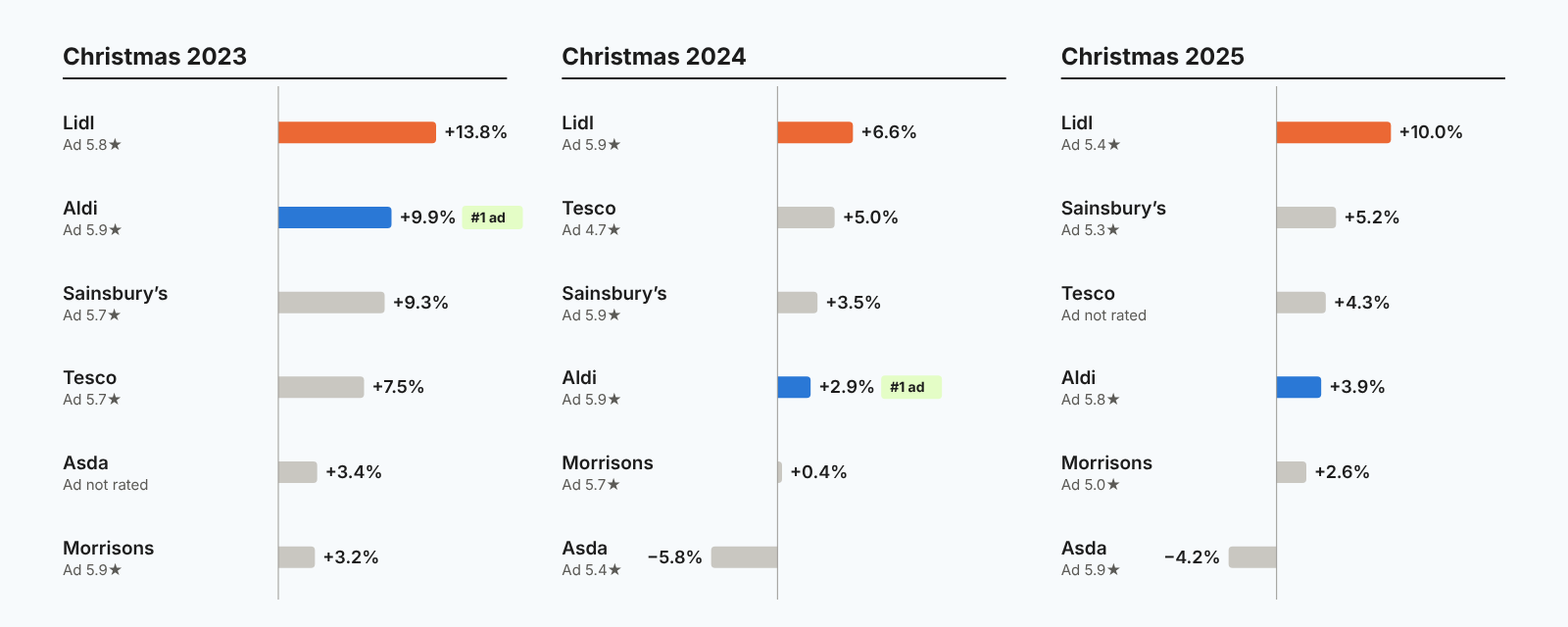
And at Christmas 2024, Aldi grew more slowly than Tesco, Sainsbury’s or Lidl. Kantar had it at +2.9%, with its share barely moving from 9.9% to 10.0%. To be fair to Aldi, it still called it its “best Christmas ever”, and in cash terms it was. But the brand with the most-loved ad in the country grew more slowly than Tesco, Sainsbury’s and Lidl that Christmas.
Lidl wins the tills
Lidl has never had the number one ad. Its scores were good, 5.8, 5.9 and 5.4, but never the winner.
It outgrew every other big supermarket at Christmas in all three years. +13.8% in 2023, +6.6% in 2024, +10% in 2025, finishing last Christmas with a record festive share, when Kantar called it the fastest-growing bricks-and-mortar grocer.
Top marks, falling sales
Aldi isn’t the only one. Two more five-star ads came with the weakest Christmases of their year.
Morrisons scored the maximum 5.9 stars in 2023, sixth in the country. Its Christmas sales grew +3.2%, the slowest of the six big supermarkets that year. Last Christmas, Asda’s Grinch ad also scored the maximum 5.9, fifth in the country. Its sales fell 4.2% and its share dropped to 11.4%.
To be fair to both, their problems were bigger than one ad: Asda in particular has been losing customers all year. But that’s rather the point. A brilliant ad can’t fix what’s behind it.
Tesco barely tries, and keeps winning
Tesco’s ads scored the lowest of the grocers: 5.7 in 2023, 4.7 in 2024, and not rated at all in System1’s 2025 tracker.
Tesco gained market share every Christmas. The biggest gain of any grocer in 2024, and last Christmas its highest share in more than a decade. Nobody is crying at the Tesco ad. Plenty of people are scanning their Clubcard.
John Lewis wins the internet
John Lewis is the opposite case. Its effectiveness scores were the weakest of the six: 3.6, 4.6 and 5.1. But it’s the only brand whose ad launch actually moves search for the brand itself. On launch day, Google searches for “John Lewis” roughly doubled in each of the last three years. Last year, launch day was its single biggest search day of the quarter, bigger than Boxing Day.
What that attention turned into is harder to say, because John Lewis doesn’t publish a Christmas trading figure. In 2024, a leaked staff memo reported that both John Lewis and Waitrose had missed their Christmas sales targets.
The one that lines up
M&S Food is the exception. A 5.9-star ad in each of the three years, and strong food sales every Christmas: like-for-like growth of 9.9%, 8.9% and 5.6%.
The difference is what’s in the ad. M&S Food’s Christmas ad is, basically, the food. It shows you the product, makes you hungry, and tells you where to buy it.
What’s actually going on
Run this through the funnel I use for everything, and the pattern makes sense.
The ads Britain loves are built for the top of the funnel. Kevin the Carrot and John Lewis’s storytelling are brilliant at the first stage: getting noticed, getting talked about, getting shared. That’s real value, and over years it builds a brand people warm to.
But Christmas trading is won further down. Lidl, Tesco and M&S Food all put the things that close a sale in front of people: the product, the price, the reason to come back. Tesco’s Christmas isn’t really an ad, it’s Clubcard Prices. Lidl’s is value. M&S Food’s is the food itself.
Being loved and being chosen are different jobs. Christmas just happens to be the week they’re tested side by side.
The caveat
None of this proves an ad caused anything. Christmas sales depend on price, stock, new stores, the weather and a grocery price war. The retailers measure different periods in different ways: Aldi and Lidl report total sales, so new stores flatter their growth, while Tesco reports like-for-like. And System1 measures emotion and long-term potential, not this year’s sales.
So the claim isn’t that the loved ad lost. It’s that the loved ad and the winning till rarely belong to the same brand. That’s worth knowing if you’re the one signing off the Christmas budget.
This year
The 2026 ads have started landing this week, and John Lewis has already posted its best System1 score since 2019. This time I’ll score each one on all eight stages, not just the tears. Then in January, when the trading updates arrive, we’ll find out who actually won.
Place your bets now. Kevin, or the tills?
Sources
- Ad effectiveness scores: System1 Test Your Ad, UK Christmas rankings 2023, 2024 and 2025 (2025 tracker); John Lewis scores via Marketing Week (2023, 2024); Tesco 2024 via Because of Marketing.
- Grocery market share and growth (12 weeks to Christmas): Kantar Worldpanel 2023 and 2025; 2024 via Grocery Gazette; Asda and Morrisons via Grocery Gazette, MarketScreener and Retail Gazette.
- Christmas trading updates: Tesco (2023, 2024, 2025); Sainsbury’s (2023, 2024, 2025); M&S Food (2023, 2024, 2025); Aldi (2023, 2024, 2025); Lidl (2023, 2024, 2025); John Lewis (2024 memo).
- Search interest: Google Trends, UK, daily searches for “John Lewis”, October to December 2023, 2024 and 2025 (pulled 2 November 2026). Launch-day lift is the launch day against the average of the seven days before it.