
Amazon is the most successful retailer in history. I want to be clear about that before we go wandering round its graveyard, because this isn’t a pile-on. It’s a story about knowing which part of the funnel you own. Amazon owns one part better than anyone alive. It just keeps trying to own the others too, and it keeps having to dig a hole.
So grab a torch.
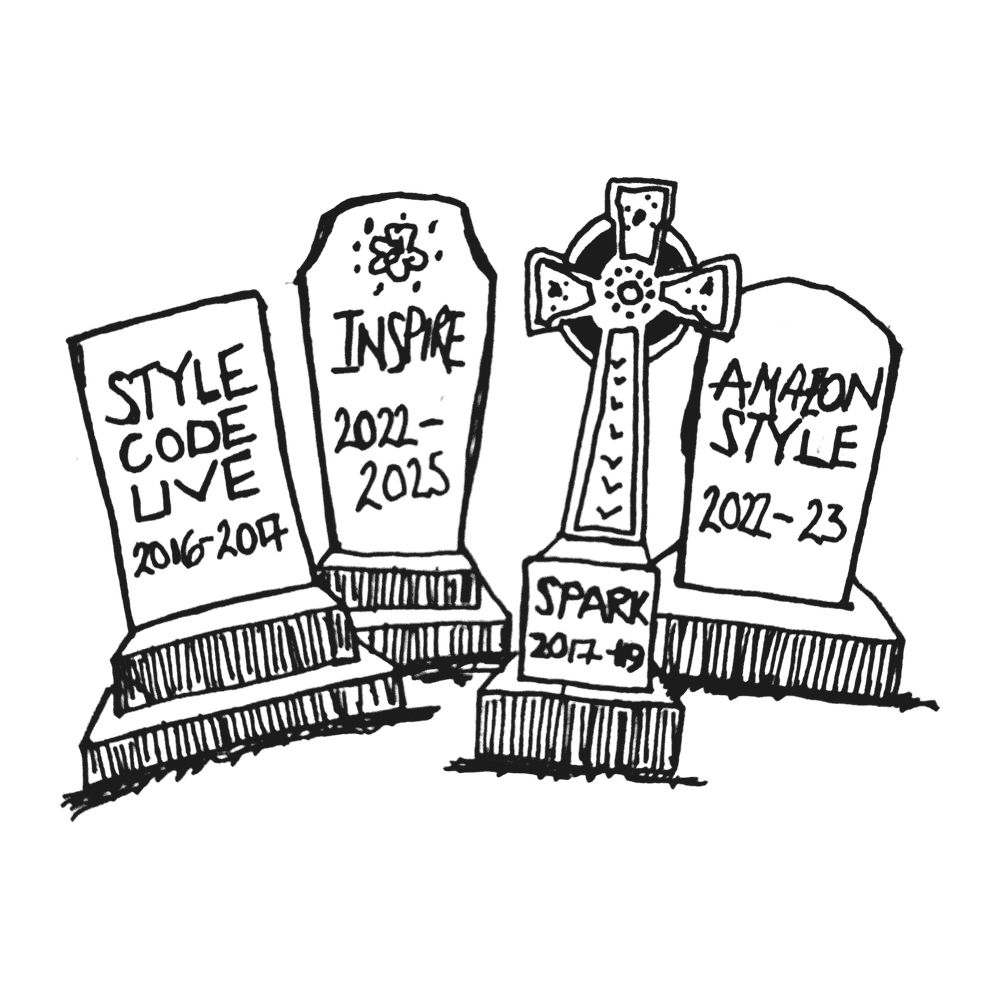
The headstones
Style Code Live, 2016–2017. A live fashion and beauty show, streamed on Amazon, with presenters, guests and buy buttons. QVC for the smartphone era. It was cancelled the following spring.
Spark, 2017–2019. Amazon’s answer to Instagram: a feed of shoppable posts from customers and influencers. Two years later it was quietly shut and folded into a hashtag.
Inspire, 2022–2025. Amazon’s answer to TikTok: a scrolling feed of short shoppable videos inside the app. It was switched off in February 2025, as TikTok Shop was expanding.
Amazon Style, 2022–2023. Two physical fashion shops in the US, packed with technology, where you scanned clothes into a fitting room. Both closed after less than two years, with Amazon saying it would focus on fashion online.
And a little further along the path, a family plot: 68 bookshops, 4-star stores and pop-ups across the US and UK, all closed in 2022.
Every one of these was an attempt to make Amazon a place you go to be inspired. To browse. To discover something you didn’t know you wanted. And every one was buried.
Why the ghosts don’t stick around
Because that’s not why anyone goes to Amazon.
You go to Amazon knowing what you want. You’ve already decided on the thing, or at least the type of thing, and now you want to check the price, read the reviews and find out if it’ll arrive by Thursday. One study found that over half of searches for a named brand start on Amazon. For a generic product, something like “running shoes”, most people still start on Google.
In funnel terms, Amazon is the greatest Buys stage ever built. It’s the till. It’s a brilliant till: fast, cheap, trusted, open all night. But nobody walks up to a till looking for inspiration. By the time you’re there, the inspiring already happened somewhere else: on Instagram, on TikTok, in a magazine, in a mate’s kitchen.
Trying to turn the checkout into the shop window is like trying to make the queue at the post office the fun part of your day. It’s not a creativity problem. It’s a stage problem.
The zombie
Now, there is one thing in this graveyard that refuses to stay dead.
In 2018, Amazon, the company that did more than anyone to kill the printed catalogue, started posting a printed toy catalogue through people’s letterboxes before Christmas. It was still turning up last Christmas.
It’s a medium that should be long dead, shuffling on through the letterbox every November, and the only one of Amazon’s discovery ideas that hasn’t been buried. That isn’t the same as it working.
I have a soft spot for a catalogue. A Smyths one landed on my doormat a few weeks ago, and I jokingly told my husband to turn down the corners of anything he wanted, like we did as kids. Thirty minutes of flicking through it brings all the feelings back. Will we buy anything from it? Probably not.
I’ve also been the person responsible for one. At JML we put a catalogue in every box that went out. It was a massive pain to produce, and the repeat purchases it was meant to drive very rarely happened.
Even the king of catalogues gave up. The Argos catalogue launched in 1973 and ran to 93 editions and more than a billion copies (my mother-in-law modelled for it in the 70s, so I take this personally); at one point only the Bible was in more UK homes. In 2020, Argos stopped printing it, saying shoppers had moved to its app, website and in-store screens. So Britain’s biggest catalogue business stopped printing two years after the company that did more than anyone to kill catalogues started.
For most businesses, a catalogue has to earn its keep. Amazon is the biggest till on earth: whatever the catalogue nudges, the sale lands on Amazon anyway. I doubt it can tell whether the catalogue pays its way, and I doubt it needs to care. A zombie can keep walking for years when nobody’s checking its pulse.
The new arrival
To be fair to Amazon, something new is moving in the dark.
Its AI shopping assistant, now called Alexa for Shopping, is the first of these experiments that looks like it’s working. Amazon says more than 350 million people have used it, and that they spend around 40% more per order. Those are Amazon’s own numbers, so pinch of salt, but they’re big ones.
Look at what it actually does, though. It doesn’t inspire you. It helps you choose. “Which of these is better for a small kitchen?” is still a question asked by someone who’s already decided to buy a kettle. It moves Amazon one stage up the funnel, from the till to the comparison, not all the way to the shop window. Which is probably why it’s the one that’s working.
The real monster
Here’s the twist in the tale. Amazon doesn’t need its own top of the funnel. It feeds on everyone else’s.
Amazon made over $68 billion from advertising in 2025. Some of that is brands paying to appear in Amazon’s own search results. A growing share is Amazon selling attention elsewhere: adverts in Prime Video, which now reaches hundreds of millions of viewers with its ad-supported tier, in live sport, and across other people’s websites and TV apps.
So other brands pay Amazon to build their awareness, and then the sale happens on Amazon’s till. Amazon gets paid at the top of the funnel and the bottom, without ever having to make anyone fall in love with Amazon itself. That’s not a failure to build a shop window. It’s renting out everyone else’s.
The moral of the story
The lesson isn’t “Amazon got it wrong”. It’s that the best businesses know which stage of the funnel they own, and build around it rather than against it.
Amazon spent the best part of a decade trying to dress up as Instagram, TikTok and a Bond Street boutique. The bits that worked are the ones that leaned into what it already is: the place you go when you’ve made up your mind.
Plenty of businesses I work with have their own graveyard: the community nobody joined, the podcast that ran for six episodes, the brand campaign bolted onto a business that wins on price. Usually the problem wasn’t the idea. It was asking a part of the business to do a job its customers never came to it for.
So this Halloween, it’s worth asking: what’s buried in your marketing graveyard, and which stage were you really trying to own?
Sources
- Style Code Live cancelled (Engadget, May 2017)
- Amazon Spark shut down (TechCrunch, June 2019)
- Amazon Inspire shut down (Retail TouchPoints, Feb 2025)
- Amazon Style stores closing (GeekWire, Nov 2023)
- Amazon closes 68 bookshops, 4-star and pop-up stores (CNBC, Mar 2022)
- Do most searches really start on Amazon? (eMarketer, BrandVerity data)
- 50% of product searches start on Amazon (Search Engine Land, PowerReviews 2023)
- Amazon mails its first toy catalogue (Retail Dive, Nov 2018)
- Argos closes the book on its print catalogue (STV News, Jul 2020)
- Argos to axe catalogue after almost 50 years (Prolific North, Jul 2020)
- Alexa for Shopping adoption figures (Retail Dive, 2026)
- Amazon ad revenue passes $68bn (Marketing Dive, Feb 2026)